


News
New insights into distinct tendon cell populations provide a foundation for future in vitro models
16 September 2026
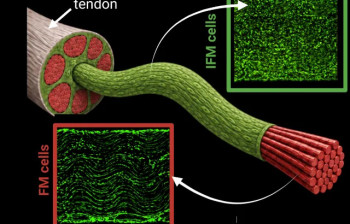
Schematic of tendon architecture highlighting interfascicular matrix (IFM) and fascicular matrix (FM) regions, which contain distinct cell populations with unique phenotypic and mechanosensitive characteristics.
Researchers at Queen Mary University of London have established the first defined culture framework for the long-term isolation and maintenance of enriched interfascicular matrix (IFM) and fascicular matrix (FM) cell populations.
Published in Advanced Science, the study led by Prof Hazel Screen and Dr Simon Grossemy demonstrates that IFM cells represent a highly mechanosensitive tendon cell population, showing marked changes in morphology, proliferation and gene expression in response to substrate stiffness. Importantly, these characteristics were partially recoverable under compliant culture conditions that better mimic the native IFM environment.
The work provides a new platform for studying tendon cell heterogeneity and mechanobiology in vitro, while supporting the development of more physiologically relevant models of tendon function and disease.
Email: h.r.c.screen@qmul.ac.uk
Link: https://advanced.onlinelibrary.wiley.com/doi/10.1002/advs.77...
Updated by: Josephine Wu