


Microvascularised Tumour-on-Chip
Context of Use or Disease: Tumour invasion, tumour-vascular interactions, angiogenesis, tumour microenvironment interactions, early metastatic processes
DOI: F1000 Research 2024, bioRxiv 2024
Platform: Microfluidic chip
Description: The model is implemented in a microfluidic chip containing a central 3D extracellular matrix (ECM) hydrogel region (e.g. fibrin or collagen) flanked by perfusable microchannels. Human endothelial cells self-assemble within the matrix to form interconnected, lumenised vascular networks under flow. Tumour cells are embedded within or adjacent to the ECM compartment, enabling direct interaction with the vascular network. Stromal components such as fibroblasts are included to support matrix remodelling and vascular maturation. The platform supports live imaging of tumour cell invasion, migration toward vessels, and intravasation events.
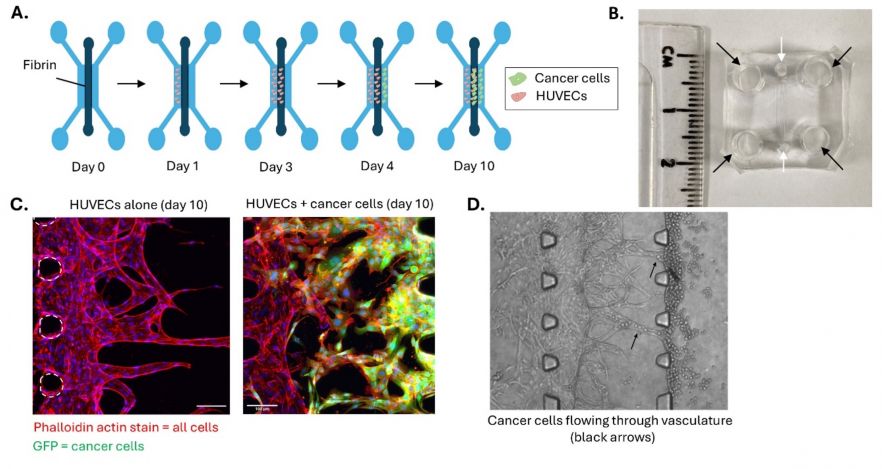
Fig. 1. Vascularised tumour-on-a-chip platform where a central fibrin hydrogel supports self-assembled endothelial networks. A. Human Umbilical Vein Endothelial Cells (HUVECs) are introduced into the left-hand side channel and allowed to vascularise the central fibrin gel. Tumour cells are then introduced into the right-hand side channel. B. A photograph of a chip, showing the entry ports for the side channels (black arrows) and central channel (white arrows). C. Immunofluorescent imaging of GFP-tagged cancer cells interacting with a vasculature. D. Brightfield imaging of tumour cells infiltrating a vascularised environment. Black arrows indicate tumour cells moving through the vasculature.
Characterisation & Validation: The model reproducibly forms lumenised microvascular networks exhibiting endothelial junction formation and barrier function. Functional perfusion is demonstrated through tracer flow and vessel connectivity. Tumour cells display invasive phenotypes within the ECM, including directional migration and interaction with endothelial structures. Evidence of intravasation-like behaviour and matrix remodelling is observed. The system responds to experimental perturbations (such as gene knockdown in the cancer cells) with measurable changes in invasion dynamics, vascular integrity, and cell-cell interactions. Human tissue studies, using tissue from our cancer biobank, back up the findings from chip studies.
Ongoing Research: Incorporation of immune cell populations, fibroblasts, and different vascular cell populations; tuneable ECM composition and stiffness; integration of patient-derived tumour cells; evaluation of anti-cancer and anti-angiogenic therapies; development of multiplexed readouts and higher-throughput chip formats
Research Team: Adrian Biddle, Abigail Coetzee
Lead Contact: Adrian Biddle
Last updated 02/07/2026