

News
November 2025 | ||
![]() 45,000 people watch Will Young's visit to Queen Mary28 November 2025It was fantastic to host musician Will Young, as he visited the Queen Mary Centre for Predcitive in vitro Models to learn more about how organ-on-a-chip technology may be used to reduce the use of animals in science. An organ-chip is a miniture device in which living cells can be ... [more] | ||
![]() Beginning of the end?27 November 2025Hazel Screen, Professor of Biomedical Engineering at Queen Mary and co-director of the Centre for Predictive in vitro Models, spoke to The Guardian's Science Weekly podcast about what the potential of in vitro models to be used in research to replace the use of animal models. [more] | ||
![]() Queen Mary launches world's first masters degree in organ-on-a-chip technology26 November 2025Queen Mary is proud to launch a new specialist bioengineering programme, MSc Organ-on-a-Chip Technologies, now open for September 2026 applications. Delivered within the renowned Centre for Predictive In Vitro Models, the course provides advanced training in next-generation organ-on-a-chip, tissue engineering and in vitro technologies. Following the Government's recently announced strategy to ... [more] | ||
![]() QMUL team qualify an organ-chip model of breast cancer metastasis using a multi-omics approach24 November 2025Researchers at Queen Mary University of London have developed and rigorously qualified a new organ-on-a-chip model that replicates the early stages of breast cancer bone metastasis, offering a promising alternative to animal studies. The microfluidic system brings together osteocytes, osteoclasts and breast cancer cells in a dynamic tri-culture, but its ... [more] | ||
![]() Will Young visits Queen Mary to explore alternatives to Animal Testing18 November 2025A group of high-profile guests visited Queen Mary's Centre for Predictive In Vitro Models on Tuesday 11th November, to explore the university's cutting-edge organ-on-a-chip facilities. The delegation included musician and animal advocate Will Young, a Director and Toxicologist from Lush cosmetics, and representatives from the charity Animal Aid. The group ... [more] | ||
![]() The Centre for Predictive in vitro Models provide expert comment on new Government strategy12 November 2025Academics at the Centre for Predictive in vitro Models at Queen Mary University of London, have provided expert comment to the BBC about the new alternatives strategy launched today (11 November) by the Department for Science, Innovation and Technology. Watch Queen Mary experts speak to the BBC about the Government's new ... [more] | ||
![]() Prof Knight interviewed in the Metro about Alternatives strategy11 November 2025Prof Knight was interviewed by the Metro related to the publication of the Governments strategy on replacing animals in science through development of 'alternative methods' such as organ-on-a-chip technology. Watch the interview and read the article in the Metro [more] | ||
October 2025 | ||
![]() Novel adipo-mimetic model to study cancer cell migration in adipose tissues17 October 2025There is increasing evidence correlating the progression of cancers such as ovarian and breast cancers or leukaemia with the microstructure and composition of their surrounding adipose (fat) tissues. In a recent reports published in Nature Communications, researchers from the CPM have shown that cancer cells migrate particularly fast in fat ... [more] | ||
September 2025 | ||
![]() Animals in Science Committee visit to Queen Mary in vitro models facilities9 September 2025We were delighted to host a visit from the UK Government's Animals in Science Committee and the associated policy unit at the Home Office. The group visited the Queen Mary in vitro models facilities, part of the Centre for Predictive in vitro Models, where we were able to demonstrate some ... [more] | ||
July 2025 | ||
![]() Queen Mary researchers awarded MRC funding to develop human tendon-on-a-chip technology11 July 2025Queen Mary University of London has secured funding from the Medical Research Council (MRC) to launch a pioneering research project aiming to transform the understanding and treatment of tendinopathy—a painful and often chronic tendon condition affecting millions worldwide. The three-year project, Human Tendon-CHIP, will combine cutting-edge bioengineering, materials science ... [more] | ||
May 2025 | ||
![]() CPM researchers develop 3D printed human skin models to better investigate immune responses16 May 2025Scientists at the CPM in Queen Mary University of London have developed advanced 3D printed human skin models that mimic key immune responses in real human tissue, opening the door to more accurate studies of skin diseases and inflammatory processes. Developed by researchers at the Blizard Institute, the novel models ... [more] | ||
CPM bioengineers achieve micro-scale breakthrough with big promise13 May 2025New techniques mimic the complexity of living human organs provide an alternative to using animals in science. Bioengineers at Queen Mary University of London have taken a significant step forward in the development of laboratory-based models of human tissues which may be used as alternatives to animal testing. The group ... [more] | ||
April 2025 | ||
![]() French National Research Agency joins push to bring organoids and organ-on-chip technology to market!4 April 2025The exploratory research program Organs and organoids on chips (PEPR MED-OOC) aims to deploy a new generation of biological models in France through the development of organs and organoids on chips (O&OoC). The State has entrusted its management to the CEA, the CNRS and Inserm, and the scientific direction ... [more] | ||
February 2025 | ||
![]() CPM researcher elected to membership of EMBO28 February 2025The centre for Predictive in vitro Models congratulates Dr Isabel M Palacios on her recent election to the European Molecular Biology Organization (EMBO) Membership. Dr Palacios is one of 100 new members joining EMBO, an organization of more than 2,000 leading researchers that promotes excellence in the life sciences in Europe and ... [more] | ||
![]() European Commission to hold the 3rd Workshop on the roadmap towards phasing out animal testing for chemical safety assessments28 February 2025On 16-17 June 2025, the European Commission (EC), in collaboration with ECHA, will organise a third workshop to discuss the roadmap to phase out animal testing for chemical safety assessments. The purpose is to present recommendations and milestone proposals of the roadmap for stakeholder consultation. [more] | ||
![]() Queen Mary University of London opens one of Europe's largest organ-on-a-chip facilities24 February 2025The new facility, which is part of the Centre for Predictive in vitro Models, will advance drug testing, reduce reliance on animal research, and train the next generation of scientists. Queen Mary University of London has officially opened one of Europe's largest and most advanced organ-on-a-chip facilities, marking a significant ... [more] | ||
![]() Queen Mary Research and Training showcased at World Organoid Research Day 202514 February 2025Researchers from the Queen Mary Centre for Predictive in vitro Models featured prominently at this year's WORD+ 2025 conference in Cambridge. At this premier UK conference on organoid and organ-chip technologies, Prof Martin Knight & Dr Stefaan Verbruggen showcased the exciting breakthroughs happening at the CPM. Additionally, the head of SEMS Prof ... [more] | ||
August 2024 | ||
![]() BBSRC are reviewing their Forward Look for UK Bioscience, originally published in 201823 August 2024BBSRC are reviewing their Forward Look for UK Bioscience, originally published in 2018: BBSRC Forward Look for UK Bioscience 2024: Community Consultation - UK Research and Innovation - Citizen Space (ukri.org) Specifically, they are consulting on bioscience priorities for the next 5-10 years, significant emerging technologies, barriers, partnerships, the role of ... [more] | ||
![]() Nuffield Council on Bioethics Call for Evidence on Neural Organoid Research23 August 2024Nuffield Council on Bioethics have opened a call for evidence seeking expert opinions on further ethical guidance needed for research using neural organoids: NCOB seeks evidence on key questions regarding the future of neural organoid research - The Nuffield Council on Bioethics (nuffieldbioethics.org) [more] | ||
July 2024 | ||
![]() Directors of Queen Mary CPM appointed to the government's Animals in Science Committee3 July 2024Prof Hazel Screen, Head of the School of Engineering and Materials Science and Professor of Biomedical Engineering, along with Prof Martin Knight, Faculty Dean for Research and Professor of Mechanobiology, have been appointed to the government's Animals in Science Committee (ASC). The two are appointed in a job share capacity, ... [more] | ||
June 2024 | ||
CPM Hiring for an Organ-chip Research Technician27 June 2024The Centre for Predictive in vitro Models at QMUL is looking for a hard-working research technician with excellent organizational skills and practical expertise in cell culture and related laboratory techniques to help run our state-of-the-art organ-chip facility. The successful candidate will work closely with researchers and other technicians supporting experiments, ... [more] | ||
![]() Queen Mary rises to 92 among global universities25 June 2024Queen Mary University of London has been ranked 92nd in the world and 9th in the UK in the 2024-25 edition of the influential U.S. News & World Report Best Global Universities rankings. The U.S. News & World Report ranking assesses the world's top 2,250 universities across a range of measures ... [more] | ||
May 2024 | ||
![]() Queen Mary University London leads £1.7 million project to revolutionise drug discovery with next-generation organ-chip technology17 May 2024Queen Mary University of London in collaboration with a consortium of leading pharmaceutical companies, organ-chip technology providers, and regulatory bodies, has secured a £1.7 million research grant from the Engineering and Physical Sciences Research Council (EPSRC) to develop a groundbreaking approach to drug discovery. An organ-chip is a bioengineered microfluidic system ... [more] | ||
April 2024 | ||
![]() Prof Knight contributes to organ-chip panel at Target to Patient conference29 April 2024Prof Knight gave an invited lecture and sat on an organ-chip discussion panel at the excellent 'Target to Patient 2024' Conference. Prof Knight was part of the session on 'Novel tools and approaches in complex in vitro cellular models' and shared the panel with Dr Lorna Ewart from Emulate Inc ... [more] | ||
![]() CPM helping to shape policy discussions on NAMs and organ-chip technology25 April 2024The Cosmetic, Toiletry & Perfumery Association (CTPA) is calling for a dedicated UK Government Strategy on New Approach Methodologies (NAMs) and related predictive in vitro models. The CTPA held a special seminar to discuss this call for progress in the adoption of animal-free safety science for chemicals. Prof Knight, from Queen ... [more] | ||
March 2024 | ||
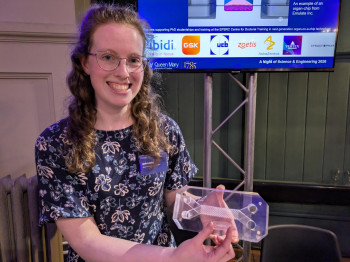
![]() Queen Mary team awarded £7 million grant to train next generation of organ-on-a-chip scientists and bioengineers13 March 2024A team of bioengineers led by Professor Hazel Screen have been awarded a £7 million grant to establish an EPSRC Centre for Doctoral Training (CDT) in Next Generation Organ-on-a-Chip Technologies. Queen Mary University of London is one of sixty-five universities chosen to receive funding from the Engineering and Physical Sciences Research ... [more] | ||
January 2024 | ||
![]() Hazel Screen on BBC TV's Operation Ouch! talking about organ-chips24 January 2024Professor Hazel Screen of the Centre for Bioengineering recently took on a new challenge: explaining the fascinating world of organ-chips technology to the young audience of CBBC Operation Ouch! You can watch on the BBC iplayer the episode which was filmed in our Organ-Chip Centre: https://www.bbc.co.uk/... [more] | ||
November 2023 | ||
![]() Development of bone metastasis organ-chip supports identification of novel drug targets16 November 2023A new paper published in Advanced Science outlines findings by Dr Stefaan Verbruggen and his group at Queen Mary University of London. The study found that osteocytes can use an immune mechanism to suppress the growth of invading breast and prostate cancer cells. However, cancer cells can intervene to prevent ... [more] | ||
October 2023 | ||
![]() Successful EU Doctoral Network grant - new organ-chip PhD available18 October 2023Prof Martin Knight is part of a recently successful Horizon Europe Marie Skłodowska-Curie and UKRI funded Doctoral Network (MSCA DN) entitled "SurfEx": Epithelial Exchange Surfaces – From organising principles to novel culture models of the gatekeepers of the body. We are now advertising a new PhD studentship based in Prof ... [more] | ||
![]() New organ-on-a-chip model of human synovium could accelerate development of treatments for arthritis16 October 2023Researchers at the Centre for Predictive in vitro Models at Queen Mary University of London have developed a new organ-on-a-chip model of the human synovium, a membrane-like tissue that lines the joints. The model, published in the journal Biomedical Materials, could help researchers better understand the mechanisms of arthritis and ... [more] | ||
September 2023 | ||
![]() CPM presentations at the BioMedEng conference15 September 2023It was great to see lots of excellent research presentations from CPM staff and PhD students at the recent BioMedEng23 conference in Swansea. There were presentations on various organ-on-a-chip models being developed at Queen Mary's Centre for Predictive in vitro Models. These included models of synovium, cartilage, bone, tendon and ... [more] | ||