


Cerebellar Organoid
Context of Use or Disease: Embryonic and early postnatal development of the cerebellum, cancer and developmental abnormalities
Platform: Organoid
Description: Starting from expanded potential stem cells (EPSCs) we have developed robust protocols to achieve cerebellar region-specific differentiation. Progenitor populations within these organoids can be genetically engineered to initiate tumourigenesis, and primary human brain tumour cells can be co-cultured with organoids to model tumour growth within a relevant microenvironmental niche.
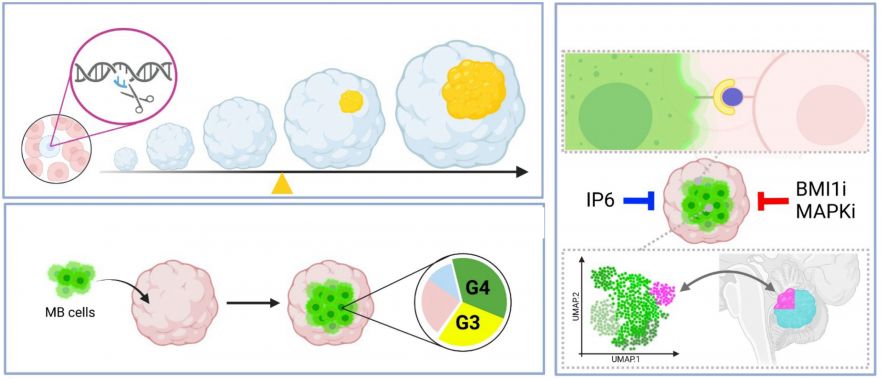
Fig. 1. Schematic showing application of the model to study the cerebellar tumour medulloblastoma, including genetically engineering cells to study tumour initiation, co-culturing of human tumour cells to study interactions with the microenvironment and drug treatment in a high-fidelity 3D human context.
Characterisation & Validation: This model has been extensively characterised using single-cell transcriptomic profiling and bulk epigenetic analyses. By leveraging similarly well-annotated collections of human brain tissue, we have been able to accurately stage our organoids developmentally and assess the fidelity with which they recapitulate key features of the human cerebellum.
Research Team: Silvia Marino
Lead Contact: Silvia Marino
Last updated 05/05/2026