


Full Thickness Skin
Context of Use or Disease: Epidermal barrier homeostasis, lipid deficiency and barrier damage, ichthyoses (genetic skin disease)
DOI: JID Innovations 2025, Biomolecules 2022, Current Protocols 2022
Platform: Transwell
Description: Bi-layered, 3D human skin equivalents are constructed by first embedding human dermal fibroblasts within hydrogels derived from decellularised extracellular matrix of porcine or human skin. N/TERT-1 keratinocytes are then seeded on the surface and cultured at the air-liquid interface to form a stratified and differentiated epidermis. To inhibit lipid synthesis and mimic barrier damage, dry skin, or ichthyoses, keratinocytes can be genetically engineered to express inducible short-hairpin RNAs targeting specific components of lipid biosynthetic pathways under the control of doxycycline. Addition or removal of doxycycline to the culture medium can then be used to tune the level of lipid impairment.
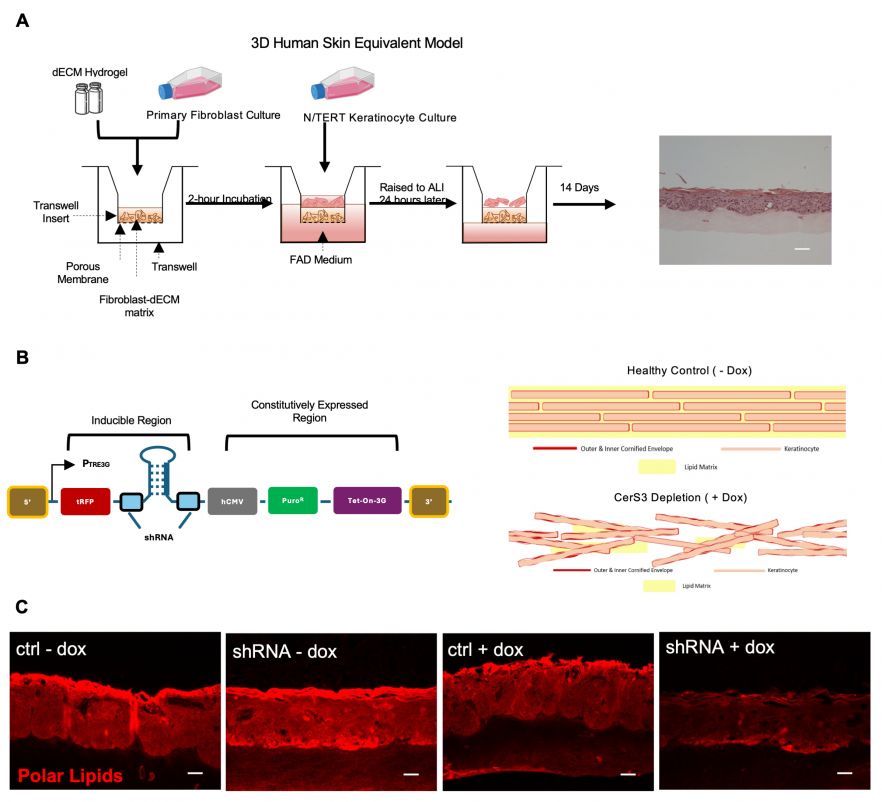
Fig. 1. A. Schematic skin equivalent construction with example H&E image. B. Schematic of inducible shRNA construct and inhibition of ceramide synthesis with doxycycline-induced knockdown of the ceramide synthase 3 (CERS3). C. Representative images of human skin equivalents constructed with keratinocytes expressing control or CERS3 shRNAs with or without doxycycline induction. Scale bars = 50 μm
Characterisation & Validation: The model replicates full thickness human skin with epidermal stratification and barrier formation under normal homeostatic conditions. Lipid impairment mimicking dry skin or ichthyosis can be modelled by knockdown of key lipid biosynthetic enzymes. Cellular phenotypes have been characterised by immunofluorescence staining, and barrier composition and function has been validated by lipidomic profiling and transepithelial resistance. The dermal hydrogel has also been characterised by proteomic mass spectrometry.
Ongoing Research: Investigation into timings and mechanisms of epidermal lipid repair following acute injury
Research Team: John Connelly
Lead Contact: John Connelly
Last updated 27/04/2026