


Neuromuscular Junction
Context of Use or Disease: Neuromuscular diseases, neuromuscular junction (NMJ) defects caused by drug toxicity or ageing, skeletal muscle injury and regeneration, drug/gene therapy testing
DOI: Science Advances 2021, Bio-protocol 2023, Cell Reports Medicine 2025
Platform: Microfabricated microfluidic chips in 35-mm dishes
Description: The model is based on microfabricated, compartmentalised PDMS chips in which functional human neuromuscular circuits are established by co-culturing human pluripotent stem cell (PSC)-derived motor neurons with optogenetic actuators, as well as an isogenic pair of patient-derived and CRISPR-corrected skeletal muscle. Motor axons projected through microchannels to innervate myofibres, forming NMJs. The model is compatible with immunofluorescence and live-cell imaging. In response to light stimulation, PSC-derived motor neurons induce contraction of PSC-derived myofibres, enabling functional assessment of neuromuscular connectivity in health and disease.
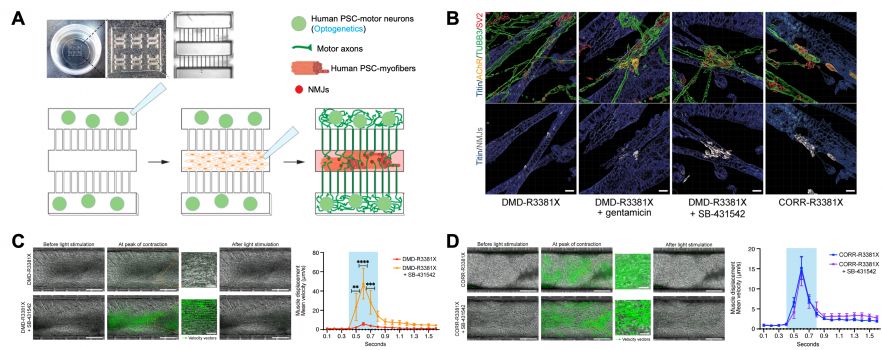
Fig. 1. A. Representation of the human microphysiological model of neuromuscular circuits. B. 3D reconstruction images of human NMJs in healthy (CORR) and diseased (Duchenne muscular dystrophy, DMD) conditions with/without drug treatment. C, D. Optogenetic stimulation of patient-derived or healthy NMJ models with/without drug treatment.
Characterisation & Validation: The model has been extensively characterised and validated using immunocytochemistry of key cellular markers, transcriptome profiling, high-content imaging and optogenetic stimulation. It accurately recapitulates NMJ defects reported in patients, e.g. reduced NMJ volume and integrity; impaired motor neuron-induced muscle contraction. NMJ defects and muscle contraction phenotypes could be rescued by pharmacological treatment in patient-derived models, compared to CRISPR-corrected isogenic controls. Human-PSC derived myogenic progenitors are capable of long-term engraftment, confirming their functional competence.
Ongoing Research: Understanding neuromuscular connectivity in health, disease and ageing, studies of soft tissue injury and regeneration on-a-chip, adaptation to a synthetic hydrogel-based NMJ model, increasing throughput with 3D printed microfluidic chips in multi-well plate format.
Research Team: Yung-Yao Lin, Julien Gautrot, John Connelly
Lead Contact: Yung-Yao Lin
Last updated 16/04/2026